A product does not deserve one AI Shopping budget. Each customer need must earn its own decision. For an agency, the useful answer is not “AI can see the product.” It is which promise to fund, which to test, and which to leave alone.
The hidden cost of “10-in-1”
Every extra product promise creates proof debt.
“Ten jobs” sounds like one strong message. In budget terms it is ten separate questions the brand may have to prove. The broader the promise, the more ways paid promotion can amplify the wrong expectation.
The new unit of planning is not the SKU. It is the SKU × the customer need × the proof required.
This is independent public research, not a customer case. Our Place did not commission, review, or endorse it. The decision uses current product facts and third-party editorial tests; no model sample is presented as a visibility score.
The first buying scene I would fund
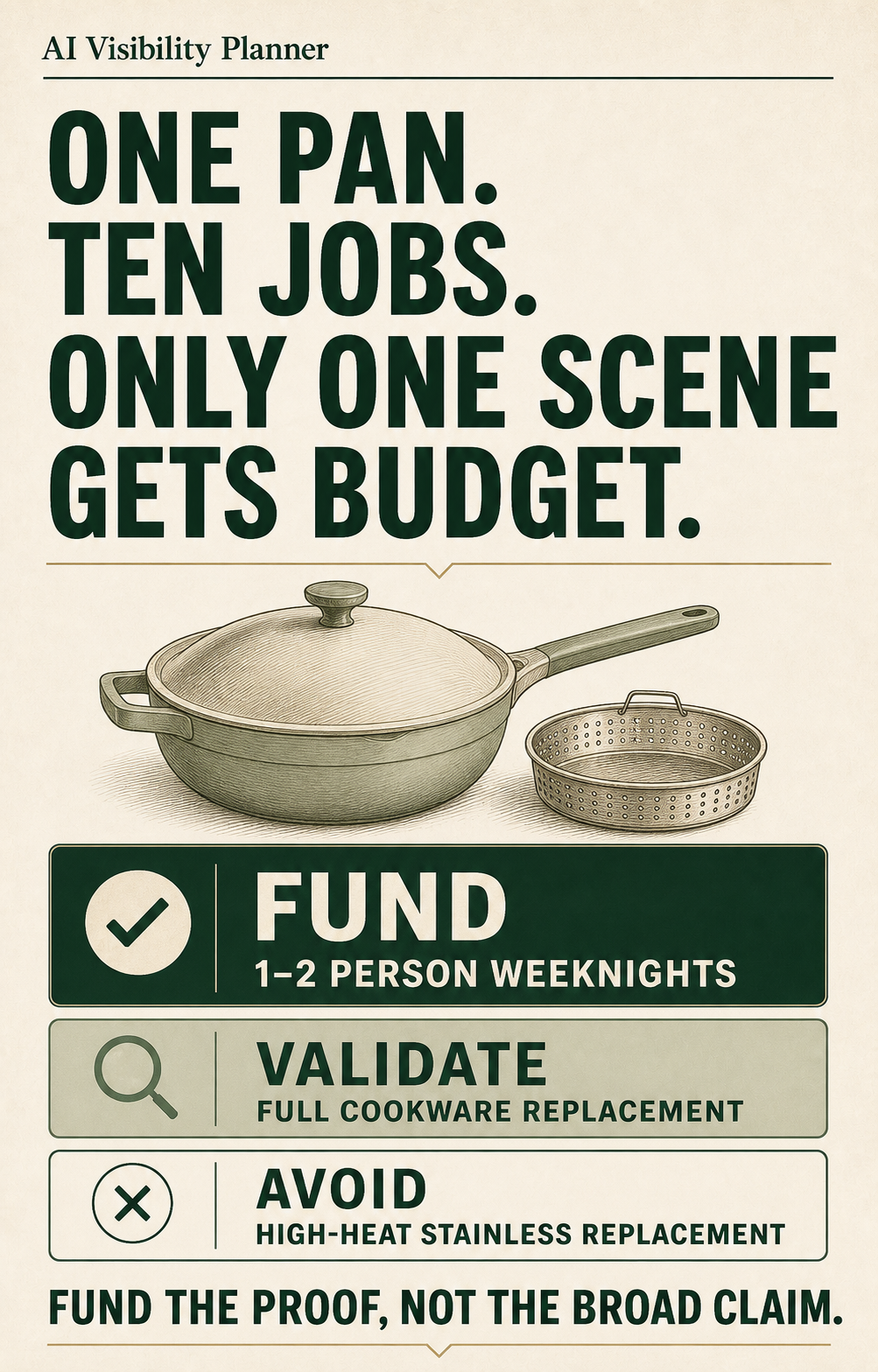
One default pan for one- or two-person weeknight meals
The standard pan is 10.5 inches and 2.6 quarts. It includes a lid, steamer basket or colander, and nesting spatula, and it is oven-safe to 450°F. Current tests used it successfully for eggs, cheese, chicken thighs, pasta, sauces, and one-pan meals.
Why this deserves budget: the customer need is narrow, the product already fits it, and the missing proof is concrete. A seven-night demonstration can show whether one pan really handles normal dinners without filling a small kitchen with cookware.
What could prove this wrong: the pan already has substantial editorial coverage, ceramic nonstick needs careful use, and the standard size may still be excessive for some solo meals. Another generic “versatile pan” article would add little.
Stop condition: downgrade to Validate if two or more of the seven meals require another primary pan, capacity repeatedly limits the intended portions, or the care routine undermines the convenience claim.
The broad claim I would test before promoting
Replacing a full cookware set for two to four people
Our Place says the pan performs ten functions and can handle a full pound of pasta. But those ten labels mix cooking jobs with included accessories, and the company also sells a separate Perfect Pot, multiple pan sizes, sets, and task-specific add-ons.
The risk: funding the broad “10-in-1 replacement” message before testing it could pay to amplify a claim that breaks on family portions, simultaneous dishes, or larger-volume meals.
Smallest useful test: predeclare seven tasks—eggs, sautéing, steaming, a full-pound pasta dish, a sauce, an oven finish, and one larger household meal—then record every time a second vessel is required.
Stop condition: if two or more core tasks need another vessel, or the household has to cook in batches, stop using “replace your cookware set” as the acquisition promise.
The buying scene that should receive $0
Replacing stainless steel for repeated high-heat searing
The ceramic Always Pan 2.0 can perform a searing function. That is not the same as replacing stainless steel for repeated high-heat work. In one current test it cooked chicken thighs but did not produce a stainless-steel-level crisp sear.
The strongest counterpoint: the official page uses “high-performance searing” language, so the function is not impossible. The evidence gap is the stronger replacement claim. Our Place itself offers a separate Titanium Pro line for higher-heat, metal-utensil, and dishwasher use.
Decision: allocate $0 in new acquisition spend to presenting the ceramic pan as a low-maintenance, high-heat stainless-steel replacement.
Reversal condition: re-enter Validate only if a current independent side-by-side test shows comparable browning across repeated high-heat use without breaking the ceramic care limits. Evidence for the Titanium Pro would be a different product decision.
Why this is not another visibility audit
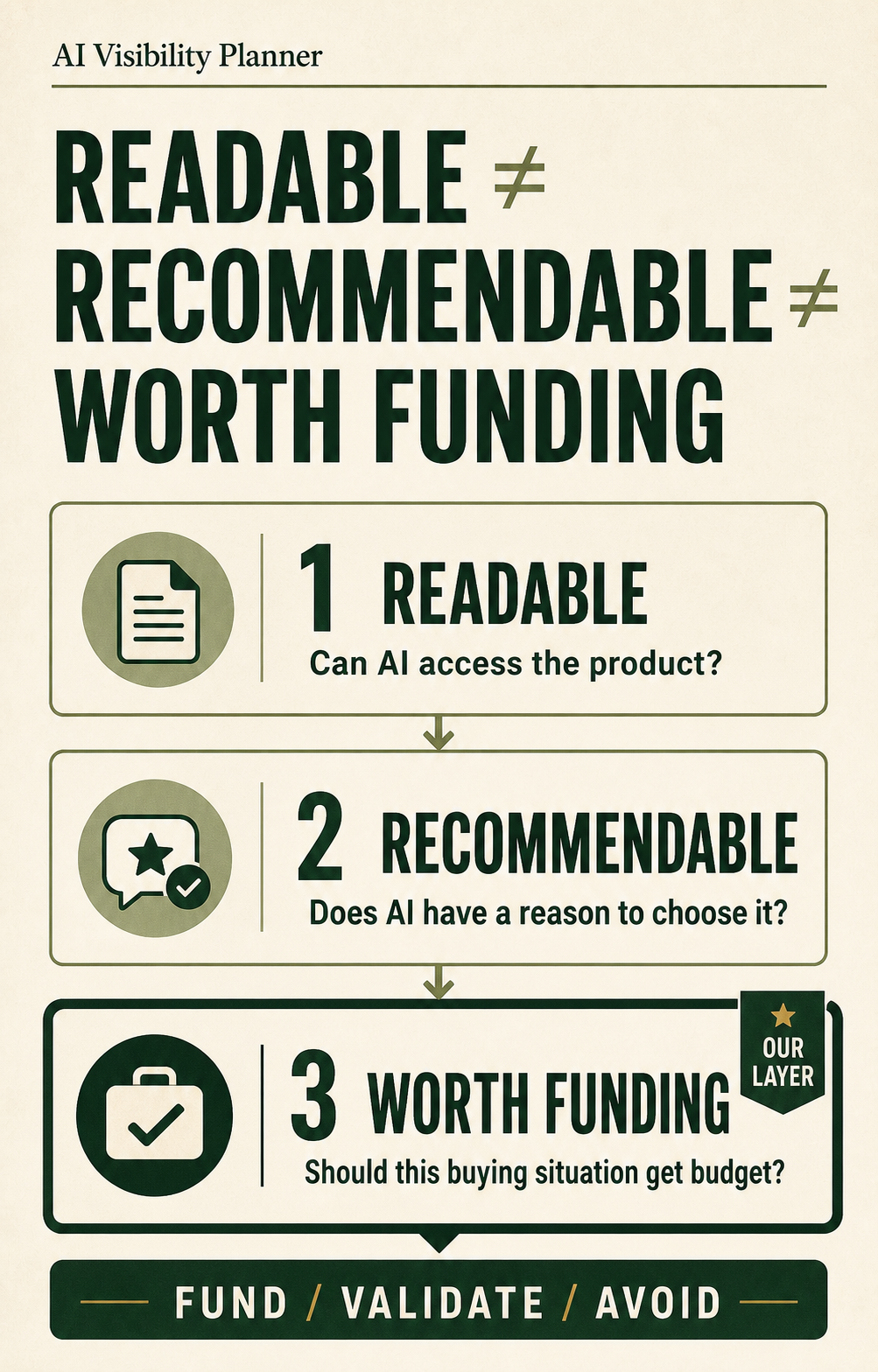
A visibility audit asks whether AI systems can access the product and whether they have a reason to mention it. A budget decision asks whether one specific buying situation deserves investment, what proof is missing, and when the team should stop.
Take this into the client meeting
A decision the agency can defend in one slide
Fund: the customer need is specific, the product fit is already credible, and the missing proof can be created in one bounded test.
Validate: the promise may be valuable, but one unresolved condition could make the campaign misleading or wasteful.
$0: more visibility would not fix the product boundary, so promotion stops before production begins.
This is the difference between reporting visibility and taking responsibility for a budget recommendation.
Public sources checked
- Our Place — Always Pan 2.0
- Shopify — Our Place growth story
- The Kitchn — Always Pan 2.0 review (2026)
- Organic Authority — real-kitchen test (2026)
- Consumer Reports — Always Pan review
Product facts and sources were checked on 2 September 2026 and may change. Affiliate-supported editorial reviews are useful evidence, but they are not neutral laboratory tests.